


Page 39 - TTG-Taiwan Transportation Equipment Guide (TTG) 2026-09 Edition
P. 39
37
                                                                                     Industry Technology


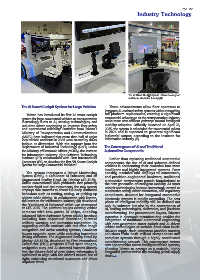
                                                                               The AI Smart Cockpit System. Photo Courtesy of
                                                                               Institute for Information Industry (III).

              The AI Smart Cockpit System for Large Vehicles       These advancements allow fleet operators to
                                                                integrate AI-assisted safety systems without requiring
                 Taiwan has introduced its first AI smart cockpit   full platform replacement, creating a significant
              system for large commercial vehicles as transportation   commercial advantage as the transportation industry
              increasingly turns to AI, sensing technologies, and   seeks more cost-efficient pathways toward intelligent
              real-time driver monitoring to improve fleet safety   mobility adoption. Officially launched on April 23,
              and operational reliability. Statistics from Taiwan's   2025, the system is scheduled for commercial rollout
              Ministry of Transportation and Communications     in 2026 and is expected to generate significant
              (MOTC) have indicated that more than half of major   industrial output, according to the Institute for
              local vehicle accidents in 2024 were caused by driver   Information Industry (III).
              fatigue or distraction. With the support from the
              Department of Industrial Technology (DoIT) under   The Convergence of AI and Traditional
              the Ministry of Economic Affairs (MOEA), the Institute   Automotive Components
              for Information Industry (III)’s Software Technology
              Institute (STI) collaborated with First International   Rather than replacing traditional automotive
              Computer (FIC) to develop the first “AI Smart Cockpit   components, the rise of AI and software-defined
              System for Large Commercial Vehicles.”            vehicles is accelerating their evolution into more
                                                                intelligent and highly integrated systems. From
                 The system integrates a Driver Monitoring      sensing modules and displays to connectors,
              System (DMS), a CamBoost AI Enhancer, and an      and precision-engineered hardware, traditional
              Augmented Reality Head-Up Display (AR-HUD).       automotive components remain foundational to
              Unlike conventional DMS platforms that primarily   the next generation of intelligent mobility. As smart
              monitor facial and eye movements, the new system   cockpit technologies become increasingly central to
              employs side cameras to detect full-body distracted   automotive safety, driver interaction, and regulatory
              behaviors such as texting, eating, or picking up   compliance, demand for integrated automotive
              objects while driving. In collaboration with Kneron,   electronic systems is rapidly expanding. The next
              the Institute for Information Industry (III) developed   phase of intelligent mobility will be defined not
              the “CamBoost AI Enhancer,” which was showcased   only by software but also by the convergence of
              at CES 2025. The platform equips existing vehicle   AI, sensing technologies, electronics, and precision
              cameras  with  low-power  AI  chips,  enabling    manufacturing. For procurement buyers, Taiwan’s
              Advanced Driver Assistance System (ADAS) functions   expertise in electronic manufacturing enables the
              including  lane  departure  detection,  forward   integration of traditional automotive engineering
              collision warning, and pedestrian recognition. By   with next-generation smart cockpit and AI-driven
              upgrading vehicle cameras with real-time image    vehicle technologies at scalable production levels.
              recognition and active warning systems, CamBoost   Taiwan’s supply chain ecosystem provides sourcing
              lowers upgrade costs while reducing hazardous     solutions from both critical components and
              driving outcomes. The Augmented Reality Head-Up   complete systems through a highly coordinated
              Display (AR-HUD), developed by First International   manufacturing network. This convergence creates
              Computer (FIC), projects  blind spot images,      new opportunities across intelligent vehicle systems,
              navigation cues, and AI-detected hazards directly   allowing Taiwan to emerge as a scalable, highly
              into the driver’s field of view. Safety information is   integrated partner within the evolving global supply
              optimized to align with the driver’s natural line of   chain.
              sight, enhancing situational awareness and driver
              response times.

