


Page 44 - TTG-Taiwan Transportation Equipment Guide (TTG) 2026-09 Edition
P. 44
42
       Industry Technology


                 Hydrogen storage systems must also be able to     For procurement buyers, MIRDC’s hydrogen
              operate under extreme conditions. During refueling,   storage technologies demonstrate how Taiwan’s
              temperatures can rise to approximately 80°C, while   suppliers are upgrading traditional components to
              liquid hydrogen applications may involve cryogenic   meet the demanding requirements of hydrogen
              temperatures approaching -253°C. At the same time,   mobility. From valves and pressure relief devices to
              onboard storage vessels commonly operate at       tubing and flow-control systems, manufacturers are
              pressures of 350 bar. As hydrogen mobility moves   leveraging advanced materials, precision engineering,
              toward commercialization, demand is growing for   and rigorous testing to deliver hydrogen solutions
              pressure, piping, sensor, and electronic systems.   that comply with international standards. As
              Existing technologies established within Taiwan's   hydrogen vehicles move toward commercialization,
              automotive sector are further advanced to create   these competencies are creating new sourcing
              higher-value hydrogen mobility applications.      opportunities through integrated functions, reduced
              Taiwan’s Metal Industries Research & Development   system size, lowered  manufacturing cost, and
              Centre’s (MIRDC) developments also provide a      improved overall performance.
              roadmap for Taiwanese manufacturers seeking
              to enter the hydrogen mobility supply chain.      Hydrogen Buses Bring Components into
              The technologies exemplified how traditional      Real-World Applications
              metal processing, fluid control, and materials
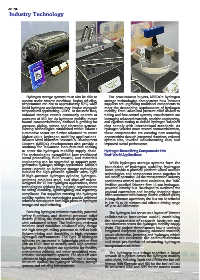
              engineering can be upgraded to support next-         While  hydrogen storage  systems  form  the
              generation hydrogen storage applications. MIRDC’s   foundation of hydrogen mobility, hydrogen
              recent upgrade on hydrogen storage technology     buses provide a practical platform where multiple
              includes the high-pressure cylinder valve, Type   technologies and components come together in
              IV high-pressure hydrogen cylinder, hydrogen-     real-world operation. As the transportation industry
              resistant stainless steel, and shut-off valves.   accelerates toward net-zero emissions, the TARC
              Designed for 70 bar hydrogen applications, these   Pavilion unveiled Taiwan’s first 16-ton hydrogen-
              technologies address key industry requirements    powered intercity bus. Developed to overcome the
              for safety, durability, lightweighting, and regulatory   payload constraints and lengthy charging times
              compliance. For suppliers entering the hydrogen   often associated with battery electric vehicles (BEVs)
              mobility market, the technologies provide validated   in long-distance operations, the bus can be refueled
              solutions that support both high-pressure hydrogen   in just 10 to 20 minutes and offers a driving range
              storage and rapid refueling.                      of up to 420 kilometers.
                 Featuring hydrogen-resistant materials, patented   The hydrogen bus serves as a layout of Taiwan’s
              safety functions, and thermal pressure relief     collaborative innovation model, combining
              devices (TPRDs), the designs reduce system weight   the competencies of research institutes and
              with enhanced safety. The hydrogen-resistant      manufacturers across the hydrogen mobility supply
              stainless steel combines advanced alloy design    chain. The project demonstrates how a vertically
              and high-strength rolling processes to deliver both   integrated ecosystem spanning advanced materials,
              lightweighting and durability in high-pressure    power electronics, batteries, and hydrogen vehicle
              hydrogen environments. The Type IV hydrogen       systems can accelerate the commercialization
              cylinders are structured in lightweight carbon fiber   and mass production of advancing hydrogen
              with an HDPE liner to securely store high-pressure   transportation solutions.
              hydrogen. The cylinders are applicable for forklifts,
              autonomous vehicles, and other specialized zero-     The hydrogen bus brings together a broad
              emission transportation systems. The shut-off valve   network of suppliers across the hydrogen mobility
              withstands high-pressure durability and a sealing   value chain, including Toyota and ITRI for the fuel cell
              structure optimal for hydrogen vehicles, storage   system; Delta Electronics and ITRI for the fuel cell DC/
              systems, and refueling infrastructures.           DC converter; TECO and ZEPT for the traction motor

