


Page 32 - TTG-Taiwan Transportation Equipment Guide (TTG) 2026-09 Edition
P. 32
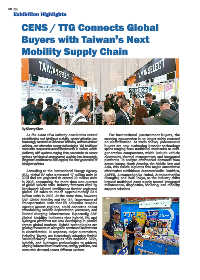
30
         Exhibition Highlights


              CENS / TTG Connects Global


              Buyers with Taiwan’s Next


              Mobility Supply Chain


              By Sherry Chen

                 As the automotive industry accelerates toward     For international procurement buyers, the
              electrification and intelligent mobility, market attention has   sourcing conversation is no longer solely centered
              increasingly centered on advanced batteries, software-defined   on electrification. At trade shows, procurement
              vehicles, and alternative energy technologies. Yet, traditional   buyers are now evaluating broader technology
              automotive components remain fundamental to modern vehicle   spans ranging from traditional mechanics to next-
              platforms, with systems ranging from powertrains to sensor   generation components, which include vehicle
              systems and thermal management, evolving into increasingly   electronics, thermal management, and integrated
              integrated architectures that support the next generation of   platforms. To analyze aftermarket demands from
              intelligent vehicles.                             across Europe, North America, the Middle East, and
                                                                Asia, this article explores five major automotive
                 According to the International Energy Agency   aftermarket exhibitions: Automechanika Frankfurt,
              (IEA), global EV sales surpassed 17 million units in   AAPEX, Automechanika Dubai, Automechanika
              2024 and are projected to exceed 20 million units   Shanghai, and IAAE Tokyo, as the industry shifts
              in 2025, accounting for more than one-quarter     beyond traditional parts supply toward integrated
              of global vehicle sales. Industry forecasts cited by   maintenance, diagnostics, servicing, and mobility
              Benchmark Mineral Intelligence further projected   support solutions.
              global EV sales to reach approximately 23.9
              million units in 2026. At the same time, however,
              S&P Global Mobility and the U.S. Department of
              Transportation note that EV adoption remains
              uneven across regions, amid concerns about
              affordability, vehicle depreciation pressures, and
              limited charging infrastructure. Expectedly, S&P
              Global Mobility indicates that hybrid, EV, and
              hydrogen platforms are now developing in parallel
              across global markets. Hybrid technologies are
              gaining momentum alongside continued investment
              in electrification. In response, major automakers,
              including Toyota, are increasingly adopting flexible
              “multipathway” strategies that combine BEVs,
              hybrids, and hydrogen technologies to address
              varying infrastructure readiness, energy policies, and
              consumer demand across different markets.

