


Page 32 - TTG-Taiwan Transportation Equipment Guide (TTG) 2026-04 Edition
P. 32
30
       Industry News


                 By synchronizing environmental parameters         Real-time monitoring captures detailed system
              with vehicle response, sensor behavior, and control   behavior aimed to provide procurement buyers
              actions, ARTC generates traceable datasets        with  high  data  repeatability. The  facility  also
              that help procurement teams validate ADAS and     supports validation of power electronics, thermal
              autonomous driving systems across perception,     management, and durability, making it particularly
              decision-making, and execution stages. This one-  relevant for suppliers pursuing multi-market
              step testing approach significantly reduces late-  strategies.
              stage design changes, shortens validation timelines,
              lowers testing costs, and accelerates compliance   From Component Suppliers to System
              with international regulations, ultimately improving   Solution Partners
              time-to-market for global manufacturers.
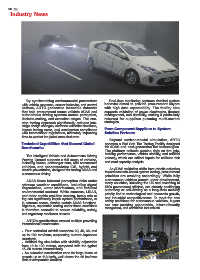
                                                                   Beyond environmental simulation, ARTC
              Technical Capabilities that Exceed Global         operates a Wet Grip Tire Testing Facility designed
              Benchmarks                                        for ADAS and next-generation tire technologies.
                                                                The platform collects precise data on tire grip,
                 The Intelligent Vehicle and Autonomous Driving   braking performance, vehicle stability, and relative
              Proving Ground supports a full range of vehicles,   velocity, which are critical inputs for collision risk
              including buses, passenger cars, and commercial   and road capacity analysis.
              vehicles, and accommodates ICE, hybrid, and
              electric powertrains, designed for testing ADAS and   As ADAS validation shifts from robotic actuation
              autonomous driving.                               toward scenario-based system testing, procurement
                                                                priorities are evolving accordingly. While fully
                 ADAS faces inherent perception risks under     autonomous vehicles remain under development,
              adverse weather conditions, including signal      many countries, including the UK and according to
              degradation, water interference, and reduced      UK’s government officials, are already positioning
              environmental contrast. While cameras, LiDAR,     autonomy or self-driving as a long-term mobility
              and radar enable real-time sensing, heavy rain or   priority tied to technological and economic growth,
              fog can significantly impair system performance, or   and industrial competitiveness. To meet the new
              in extreme cases, disable certain ADAS functions.   safety ambitions for autonomous vehicles, buyers
              Rigorous, repeatable testing under these conditions   are now seeking repeatable, internationally
              is therefore essential to ensure reliability, safety,   recognized, and certifiable test results.
              and regulatory readiness at scale.
                 ARTC’s specifications exceed multiple prevailing
              international benchmarks:

              ● Four controlled rainfall scenarios: 20, 40, 60, and
              up to 100 mm/hour, surpassing current Japanese
              standards
              ● Artificial fog simulation with visibility adjustable
              from 10 to 100 meters, compared with the typical
              15–80 meters internationally
              ● An extended acceleration zone for large buses at
              speeds up to 110 km/h, well above the 60 km/hour
              limit at comparable facilities

